Corporate Office Mural Guide: Brand, Space & Process
Plan a corporate office mural around brand identity, audience, wall selection, approvals, operations, budget and maintenance.

An office mural can translate a company's identity into space, but only when the project begins with purpose—not with the instruction to “make the logo bigger.” Reception areas, corridors, meeting rooms and social spaces speak to different audiences. This guide helps brand, marketing, facilities, architecture and management teams plan one coherent mural project.
What should a corporate mural achieve?
Start by defining the job of the wall. A mural may:
- create a recognisable first impression in reception;
- tell the company's origin, craft or future direction;
- give an empty corridor or staircase visual rhythm;
- support orientation between departments or floors;
- create a distinctive background for events and content;
- connect the workplace with its city, community or industry.
These are design goals, not automatic guarantees of productivity or sales. Clear goals allow the result to be reviewed honestly after completion.
A mural is not the same as signage or wallpaper
Signage prioritises information and immediate legibility. Printed wall covering repeats or reproduces a prepared graphic. A hand-painted mural is a site-specific artwork developed for the wall, architecture and audience.
The three can coexist. A logo sign may remain precise while the mural creates atmosphere and narrative around it. The project should decide which element carries information and which carries artistic expression.
Choose the wall by audience and viewing behaviour
The most visible wall is not always the most useful. Observe who sees it, from where and for how long:
- Reception: clients, candidates, partners and visiting teams; strong first read.
- Meeting room: closer viewing, video calls and more restrained backgrounds.
- Corridor: movement, sequence and possible wayfinding.
- Staircase: changing angles and a vertical or continuous narrative.
- Social area: informal tone and interaction at close range.
- Exterior or entrance: public visibility, permissions and weather exposure.
Build a useful corporate mural brief
A strong brief should include:
- the purpose of the wall and primary audience;
- wall dimensions, straight photographs and wide room views;
- brand guidelines, vector logos and approved colour references;
- words, values or claims that must or must not appear;
- examples of the desired mood and examples to avoid;
- existing interior materials, lighting and furniture plan;
- approval stakeholders and the person with final authority;
- deadline, working hours, access and building rules;
- budget range and procurement requirements.
A good brief defines the problem without dictating every brushstroke.
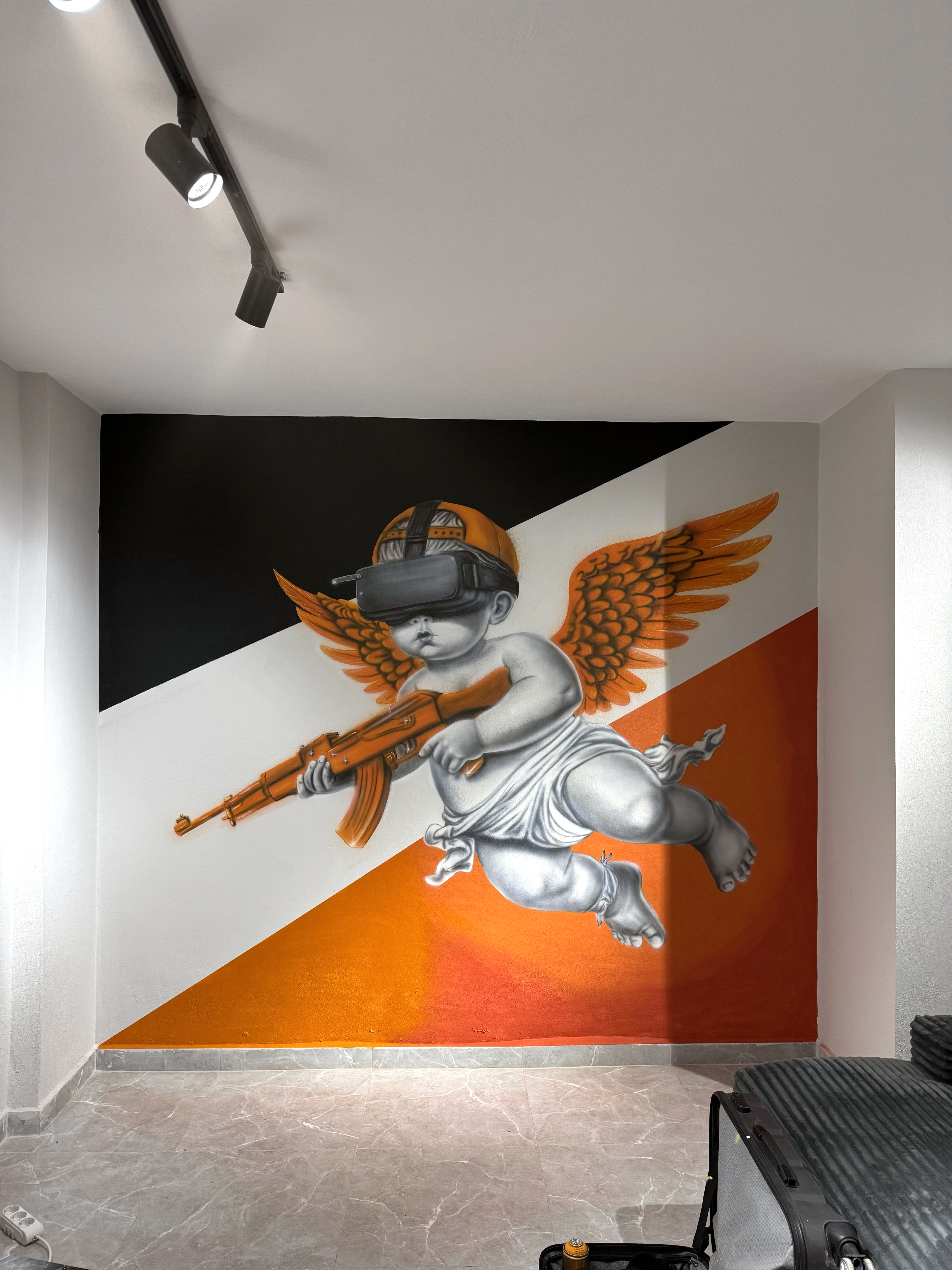
How to use brand identity without creating a giant logo
Brand identity is larger than the logo. It includes tone, history, rhythm, materials, audience, language and values. A mural can interpret these through form, colour, subject and movement.
Possible approaches include:
- an abstract composition derived from brand geometry;
- a visual narrative of the company's process or origin;
- local cultural or natural references connected to the organisation;
- selected typography integrated into an illustration;
- a restrained palette adjacent to brand colours;
- a focal logo supported by a broader artistic environment.
Brand colours: match, translate or contrast?
Exact brand colours matter when the mural contains official marks or regulated identity elements. In the artistic field around them, literal colour matching may feel mechanical. The palette can translate the brand into lighter, darker, muted or complementary relationships while preserving recognition.
Wall texture, primer, lighting and surrounding surfaces change how a physical colour appears. A screen mock-up is useful for approval but cannot reproduce the final wall exactly.
Coordinate marketing, facilities and architecture early
Corporate mural projects often fail through late stakeholder changes rather than painting technique. Marketing may focus on identity, facilities on access and durability, architects on material and proportion, and management on schedule and budget. Bring the necessary decision-makers into the brief before detailed design.
Identify one person who consolidates feedback. Contradictory comments from ten departments should not reach the artist as ten separate design directions.
Design approval, copyright and licensed material
The approval process should record the selected concept, wall, dimensions, palette direction, required text, included revisions and final decision-maker. If the design uses photographs, characters, third-party logos or licensed assets, the client must confirm the right to use them.
A mural inspired by a brand should still be an original composition. References communicate mood and direction; they are not permission to copy another artist's work.
Plan around office operations
Application may involve ladders or access equipment, protected work zones, material movement, ventilation and drying time. Decide whether work will happen during office hours, evenings, weekends or in phases.
Share security procedures, loading access, parking, lift dimensions, noise rules, staff circulation and any confidentiality restrictions. A technically simple wall can become a difficult project if access is discovered too late.
Surface, light and furniture matter
The wall must be sound, dry and compatible with the selected paint system. Moisture, cracks, loose paint and construction dust should be resolved before artistic work. Strong grazing light can reveal texture; furniture or screens may cover important parts of the design.
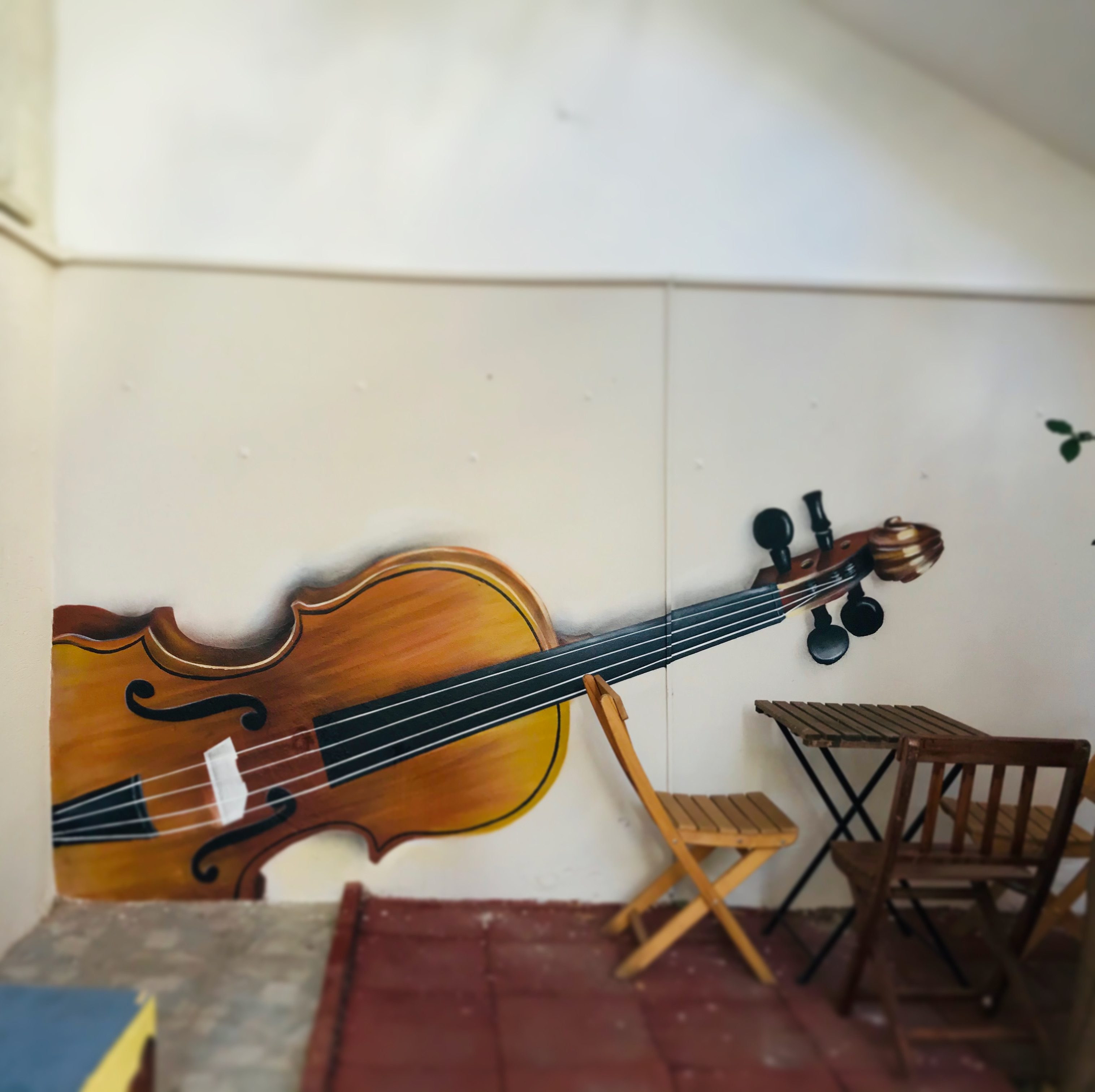
Review the mural together with the final interior plan. A composition approved on an empty wall may fail when a reception desk, cabinet or digital screen is installed in front of its focal point. The mural project process guide explains survey, surface preparation and application in detail.
How is an office mural priced?
Price depends on wall area, design complexity, surface preparation, height, access, colours, working schedule, travel and deadline. Corporate requirements such as night work, additional documentation, site induction or multiple approval rounds can also affect scope.
Square metres are only one input. A small wall with detailed typography and many revisions may require more work than a larger, graphic composition. Review the mural pricing guide before requesting a proposal.
Design for photographs and video calls without designing only for them
If a mural will appear behind speakers, events or social content, test the likely camera crop. Important faces, text and logos should not sit where people, furniture or screen interfaces will always cover them. Matte or restrained surface choices may help reduce distracting reflections.
The work should also remain meaningful when no camera is present. A mural built only as a photo frame can feel empty in everyday office life.
Maintenance and future change
Ask how the wall will be cleaned, whether furniture may move and how long the company expects to stay in the space. High-contact areas may need a different material or protection strategy from a ceiling-height lobby wall.
Keep a record of the paint system and project photographs. If branding or tenancy changes later, the mural can sometimes be adapted, partially revised or painted over after the surface is assessed.
How to evaluate the project after completion
Success should relate to the original goal. Possible observations include:
- whether visitors can identify the intended focal point;
- whether the wall appears in company photography or events;
- whether reception or wayfinding feels clearer;
- whether teams use the space as expected;
- whether maintenance demands remain reasonable.
Do not invent a financial return that cannot be measured. Document the initial purpose, photograph the completed space and collect feedback from the people who use it.
Art and architecture as one commission
Large organisations increasingly treat art as part of the built environment rather than a final decorative purchase. The U.S. General Services Administration's Art in Architecture program, for example, commissions site-specific work through collaboration between art professionals, clients, community representatives and architects. The scale is different, but the principle applies to an office wall: involve art before every architectural decision is fixed.
Corporate mural project checklist
- Define purpose and audience.
- Select the wall and photograph the full space.
- Gather brand guidelines and legal approvals.
- Confirm measurements, surface, furniture and lighting.
- Name the decision-maker and revision process.
- Set budget, procurement steps and completion date.
- Plan access, work hours and safety zones.
- Approve the site-specific concept.
- Document completion and maintenance guidance.
Frequently asked questions
Can the mural include our exact logo?
Yes, when approved vector artwork and brand rules are supplied. The logo can be a focal element or remain separate while the mural interprets the wider identity.
Can you work while the office remains open?
Sometimes. It depends on access, ventilation, staff circulation and building rules. Evening, weekend or phased work may be more suitable.
Can several office walls share one concept?
Yes. A common palette, repeated motif or continuing narrative can connect reception, corridors and meeting rooms without repeating the same image.
How early should we begin?
Begin before the final fit-out is complete when possible. Design, stakeholder approval, surface preparation, access planning and application all need time.
Do you work outside Antalya?
Yes. Projects elsewhere in Turkey can be planned with travel, accommodation, access and material logistics included clearly in the proposal.
Commission a corporate mural with Asil Argun
Explore the mural portfolio and the commercial mural guide. To request a proposal, use the project appointment form and send the city, wall dimensions, photographs, brand guide, deadline and intended purpose. Projects can be discussed in Turkish or English.